The First Principles Paradigm
When you execute a bioinformatics pipeline and a striking figure appears on your screen—a volcano plot revealing differentially expressed genes, a single-cell manifold resolving cell types, or a list of somatic variants—what exactly transpired between the biological tissue in the laboratory and the pixels in front of you?
Every bioinformatics result is the endpoint of a long, unbroken chain: a physical measurement, a digital representation, a mathematical transformation, an algorithmic heuristic, a statistical inference, and finally a biological interpretation.
If you do not understand every link in that chain, you do not truly understand your result.
A biological data file is not biology. It is a computational artifact produced by physical instruments, mathematical abstractions, and statistical assumptions. Software tools do not uncover truth; they execute operations on representations. If you cannot trace your result backward from the screen to the physics of the measurement instrument, you are operating on blind faith.
The Black-Box Trap
Modern bioinformatics is deceptively accessible. With a single shell command or a pre-packaged workflow, you can download gigabytes of high-throughput sequencing data, align millions of reads, and generate sophisticated statistical figures in minutes. Modern software has made it easier than ever to turn raw data into publication-ready visual displays.
Most of us begin our journey this way. When you are starting out, relying on black-box software tools is natural—it allows you to engage with complex biological questions quickly. But tool proficiency alone is necessary, yet fundamentally insufficient.
The trap of modern data science is confusing software execution with scientific understanding. When a software package finishes running without throwing an error, it guarantees only one thing: that the code executed syntax-valid instructions. It does not guarantee that the aligner’s seed heuristics did not discard your structural variant, that default normalization parameters did not erase true biological signal, or that technical batch effects did not drive your principal components.
When a pipeline fails silently or when published findings fail to replicate, an operator who only knows command flags is left helpless.
This book is designed as the antidote to black-box dependency. My objective is not to teach you how to memorize software flags or copy-paste code blocks. My goal is to train you as a computational architect and a forensic auditor of biological data—someone who understands the physical constraints of hardware, the topology of multidimensional algorithms, and the statistical mechanics of biological noise.
Tracing the Transformation Chain
To build an intuitive and rigorous mastery of bioinformatics, you must learn to see beyond file formats. You must internalize that every file type you encounter is merely a mathematical abstraction of a physical process:
FASTQ is not biology. It is an array of optical fluorescence intensities or ionic current fluctuations translated into ASCII characters with probabilistic Phred quality scores.
A BAM file is not biology. It is a heuristic string alignment mapped against an idealized reference genome coordinate system using Burrows-Wheeler transformations and dynamic programming score matrices.
A count matrix is not biology. It is a discrete sampling of cDNA molecules altered by reverse transcription efficiency, PCR amplification kinetics, sequencing depth, and biological overdispersion.
A PCA plot or UMAP manifold is not biology. It is a low-dimensional matrix projection or non-linear graph optimization designed to compress hyper-dimensional space onto a two-dimensional plane.
A list of differentially expressed genes is not biology. It is an inferential statistical output derived from hypothesis testing, dispersion shrinkage estimators, and false discovery rate adjustments.
Every transformation step along this chain introduces specific assumptions. If those assumptions are violated by your sample preparation, your sequencing chemistry, or your computational environment, the downstream biological conclusion collapses.
Throughout this book, I will teach you to evaluate biological data through a unified master rhythm:
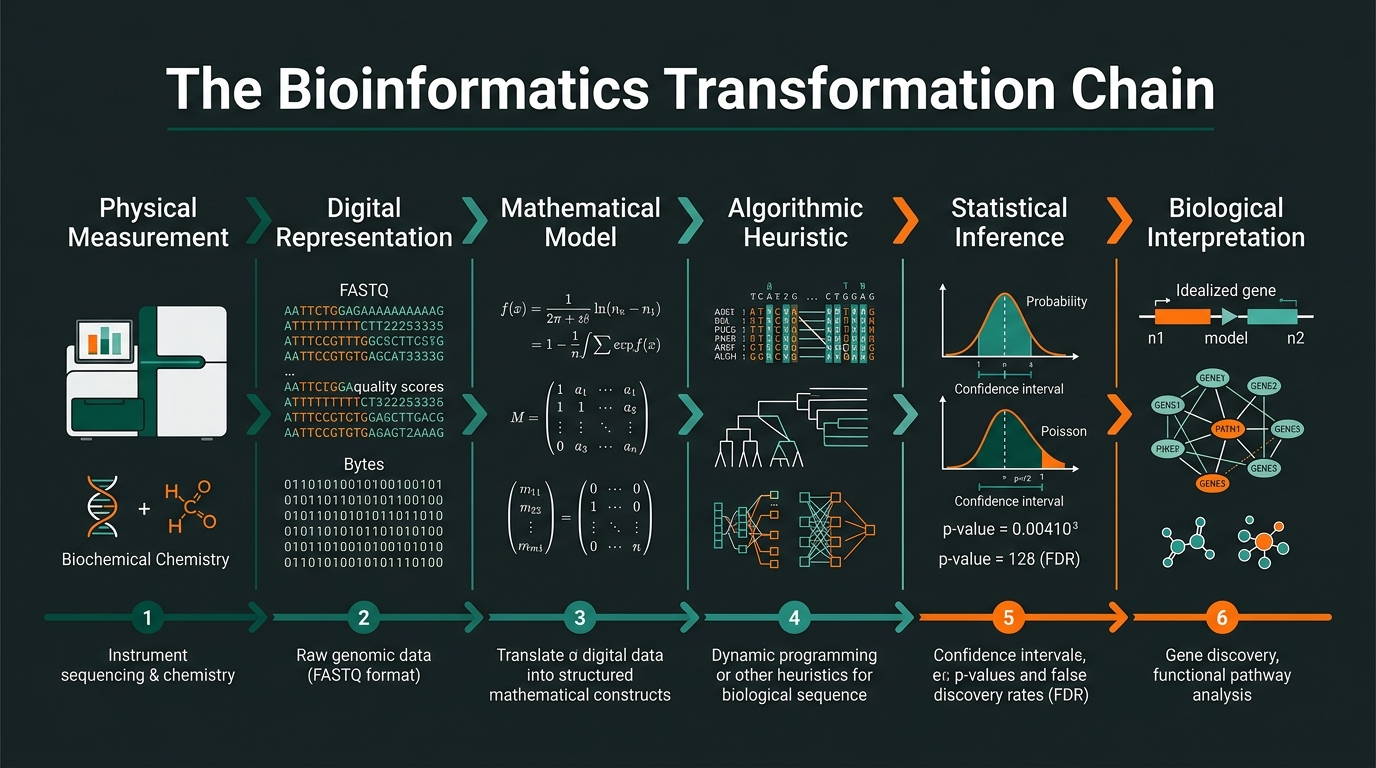
The Bioinformatics Transformation Chain. A 6-stage operational framework tracing biological data from physical instrument measurements to high-level biological conclusions: Physical Measurement (instrument optics/ion kinetics) \(\longrightarrow\) Digital Representation (FASTQ/BAM binary formats) \(\longrightarrow\) Mathematical Model (count distributions and linear algebra matrices) \(\longrightarrow\) Algorithmic Heuristic (alignment graphs and dynamic programming) \(\longrightarrow\) Statistical Inference (dispersion estimation and hypothesis testing) \(\longrightarrow\) Biological Interpretation (pathway enrichment and variant discovery).
By learning to trace this chain forward and backward, you will develop the capacity to diagnose subtle technical artifacts, construct novel analytical frameworks, and extract genuine biological signal from noisy measurements.
The Five Architectural Principles
To guide our work across this curriculum, I enforce five foundational principles:
1. First Principles Before Software Execution
You will not run an analytical package in this book until you have derived or conceptualized the physics, mathematics, and statistics that justify its existence. I will teach you:
The physics of the measurement instrument before the data representation.
The mathematics of the algorithm before the software command.
The statistics of the noise before the analysis package.
2. Cultivate the Forensic Reviewer Mindset
Do not trust a biological result until you understand precisely how it was produced. As a computational biologist, your primary responsibility is to act as a forensic auditor of data. You will learn to actively search for technical batch effects, index hopping, mapping bias, unconstrained permutations, and numerical instability. Every published dataset is an hypothesis that must be rigorously audited before its conclusions are accepted.
3. Isolation is Scientific Integrity
A pipeline that runs only on your local machine is not a scientific instrument; it is a liability. Host environment dependency drift—changes in underlying system libraries, software versions, or operating system kernels—is a physical contaminant in computational research. Every analysis you build must be version-controlled, containerized, and orchestrated via Directed Acyclic Graphs (DAGs) to guarantee identical outputs across time and compute platforms.
4. Problem-Driven Computational Tooling
Programming languages are computational tools, not ideological identities. Selecting a language based on personal comfort rather than computational constraints is anti-scientific. You will choose your platform based on the mathematical and computational requirements of the problem:
UNIX utilities and stream processing for memory-bounded byte manipulation.
Python for object-oriented systems engineering, workflow integration, and machine learning architectures.
R and Bioconductor for vector algebra, matrix operations, and statistical inference.
An elite bioinformatician is multi-lingual by necessity.
5. Replicates Before Algorithms
Computational sophistication cannot rescue flawed experimental design. A single high-throughput sequencing run is not a deterministic measurement; it is a random variable drawn from a complex probability distribution. Bioinformatics is the study of variance, and variance cannot be modeled from a single observation. You will not analyze data without biological replicates, and you will never trust a statistical signal without estimating its dispersion parameter.
Map of the Intellectual Journey
This curriculum is structured into five progressive tiers, designed to take you from fundamental hardware mechanics to clinical-grade computational architecture:
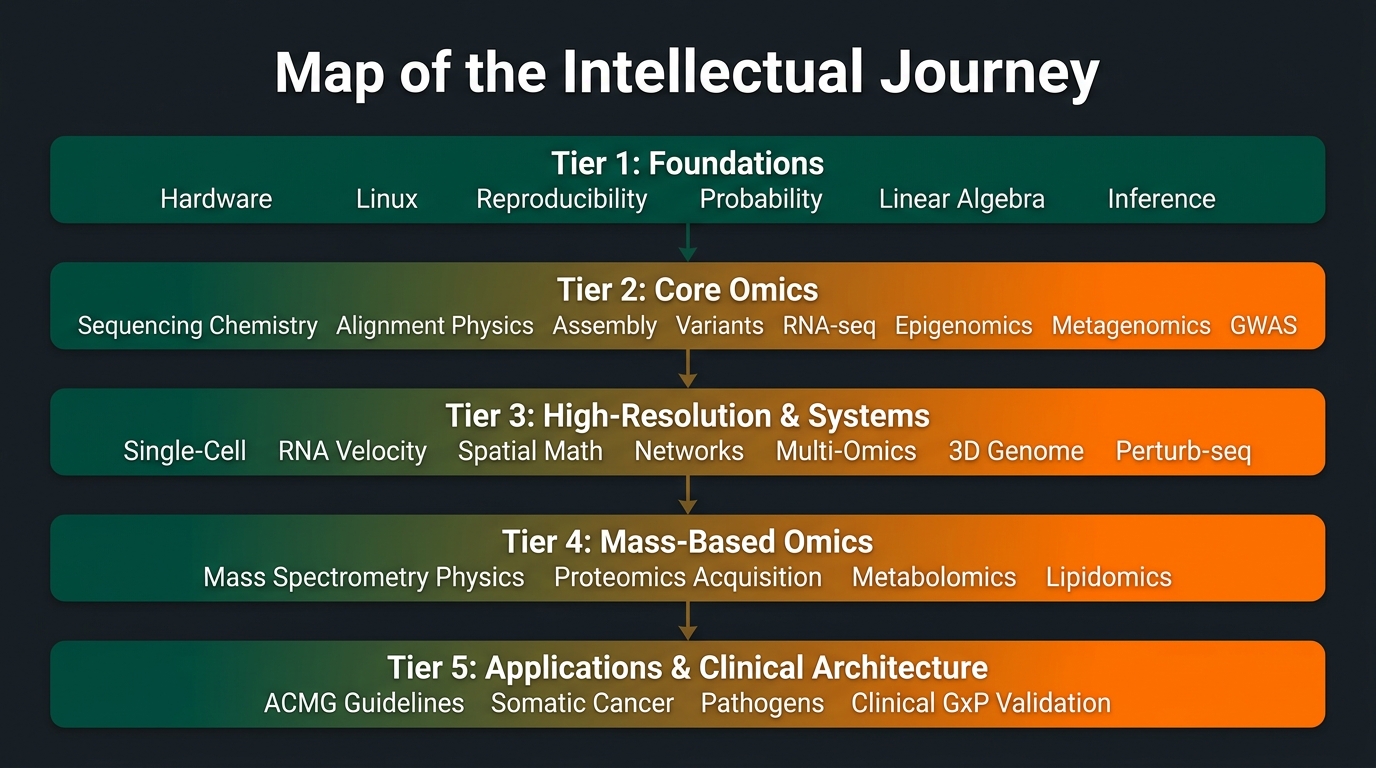
The Five-Tier Bioinformatics Curriculum Architecture. A progressive roadmap structuring 30 chapters across five core domains: Tier 1 (Foundations) builds hardware, containerization, probability, and linear algebra fundamentals; Tier 2 (Core Omics) dissects sequencing physics, alignment heuristics, variant calling, and bulk omics; Tier 3 (High-Resolution & Systems) advances to single-cell manifolds, spatial transcriptomics, and networks; Tier 4 (Mass-Based Omics) models mass spectrometry, proteomics, and metabolomics; and Tier 5 (Applications & Clinical Architecture) applies computational mechanics to clinical pipelines, cancer genomics, and ACMG guidelines.
Tier 1: Foundations (Chapters 1–6)
Before you analyze a genome, you must understand the physical compute engine. We begin with hardware constraints (CPU cache, RAM bandwidth, disk I/O bottlenecks), environment containerization (Docker, Singularity), workflow orchestration (Nextflow, Snakemake), and interval algebra. We then build the core mathematical languages of omics: probability distributions of counts (Poisson and Negative Binomial overdispersion), linear algebra (Singular Value Decomposition and PCA), and statistical confounder management.Tier 2: Core Omics (Chapters 7–14)
We dissect the physical measurement instruments and core sequence algorithms. You will learn how optical fluorescence chemistry (Illumina) and ionic current fluctuations (Nanopore) generate raw data, followed by Burrows-Wheeler indexing, de Bruijn assembly graphs, Expectation-Maximization isoform allocation, epigenomic signal modeling, metagenomic k-mer profiling, and statistical genetics.Tier 3: High-Resolution & Systems (Chapters 15–21)
We transition to single cells, spatial coordinates, and molecular networks. You will master manifold learning (t-SNE, UMAP), RNA velocity phase portraits, spatial coordinate mathematics, network graph theory (WGCNA), multi-omic latent spaces (MOFA+), 3D genome loop extrusion (Hi-C), and functional genomic CRISPR screens (Perturb-seq).Tier 4: Mass-Based Omics (Chapters 22–24)
We examine biology at the functional endpoint of execution: proteins, metabolites, and lipids. You will master mass spectrometry physics, spectral library acquisition (DDA vs. DIA), peptide-to-protein identification algorithms, metabolomic pathway annotation, and lipid class dynamics.Tier 5: Applications and Clinical Architecture (Chapters 25–30)
We apply first-principles rigor to real-world clinical and translational engineering. You will study ACMG variant classification guidelines, somatic cancer evolution and liquid biopsies, pathogen molecular clocks, clinical pipeline validation (GxP and FDA software-as-a-medical-device standards), software engineering patterns for bioinformatics, and the unresolved frontiers of pangenomics and privacy.
The Path Ahead
Becoming a computational architect requires starting where data begins—not in an abstract cloud, but inside physical hardware.
Before we can evaluate a biological dataset, we must understand what a dataset actually is: a stream of binary data moving through physical silicon transistors, stored in memory addresses, managed by an operating system kernel, and bounded by physical memory bandwidth and disk I/O.
Turn to Chapter 1, where we examine the physical foundation of all bioinformatics: The Bioinformatic Computing Environment.